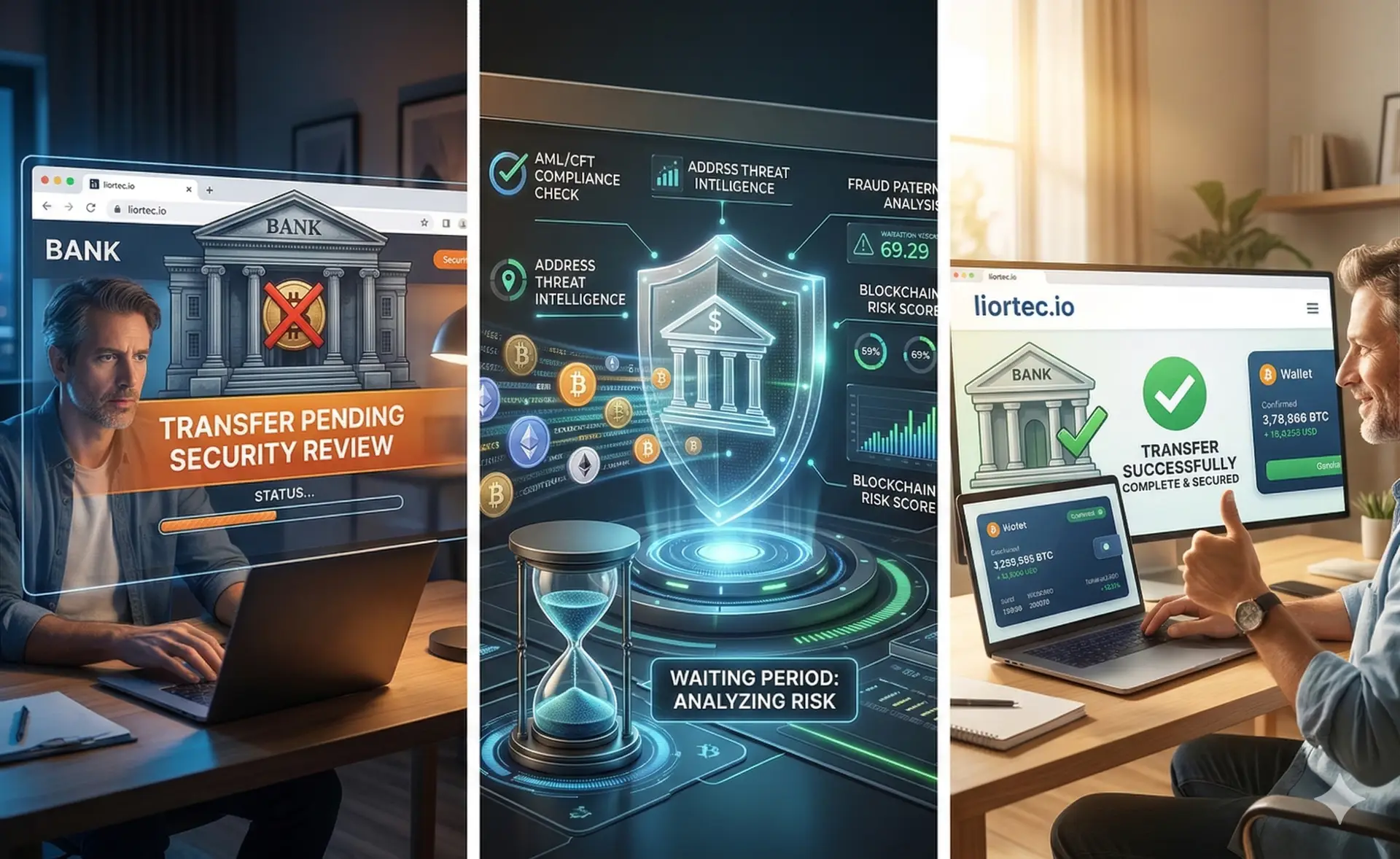
It took me more than a week to buy crypto.
Not because I didn’t have the money. Not because I didn’t know what I was doing. But because the system made it slow.
The bank was blocking my crypto transfer. The exchange required additional verification. KYC documents were reviewed. Transfers were delayed.
At first, it felt frustrating. Then I realized something important:
That waiting period wasn’t a barrier. It was a buffer.
And if you understand crypto security deeply enough, you begin to see something counterintuitive: friction protects you.
Why Banks Are Blocking Crypto Transfers
Over the past few years, financial institutions worldwide have increased scrutiny around crypto transactions. Banks operate under strict compliance frameworks involving Anti-Money Laundering (AML), Know Your Customer (KYC), risk monitoring, and fraud prevention protocols.
Crypto exchanges have also tightened onboarding procedures. This results in delayed transfers, verification holds, additional document requests, and manual review queues.
From the user perspective, it feels like resistance. From a security perspective, it introduces something valuable: time.
And time is one of the most powerful security tools you have when dealing with a bank blocking your crypto transfer.
The Real Risk Isn’t the Delay — It’s the Rush
Most beginners lose money not because of market volatility. They lose money because of pressure.
Pressure to buy before price moves. Pressure to finish registration quickly. Pressure to skip security steps, ignore red flags, use public Wi-Fi, and click fast.
The emotional state of urgency creates vulnerability. That’s where phishing thrives. That’s where fake exchange websites succeed. That’s where people send money to the wrong address.
And most of it happens in the first 72 hours.
The Psychology of “I Need to Buy Now”
Green candles are powerful. Price movement triggers dopamine. The brain interprets “price going up” as “opportunity disappearing.” This activates loss aversion — and loss aversion reduces critical thinking.
You stop evaluating risk. You start justifying shortcuts. That is when security collapses.
Sovereign wealth is not built under adrenaline. It is built under discipline.
What I Did While My Bank Was Blocking My Crypto Transfer
Instead of refreshing the exchange app every hour, I did something else. I prepared. Here’s what that week allowed me to do.
1. Hardened My Email Security
Before holding any crypto, your email is your weakest link. During the waiting period, I enabled strong 2FA (not SMS), secured my recovery email, removed unnecessary forwarding rules, checked login activity, and used a password manager to generate unique credentials.
If someone compromises your email, they can often reset exchange access. Your crypto security begins at your inbox. A password manager like NordPass ensures you never lose access to critical accounts.
2. Verified the Exchange Properly
Phishing sites during registration are common. While waiting, I double-checked the official URL, bookmark integrity, and SSL certificate validity. I confirmed I had not clicked through ads and was not on a spoofed domain.
Many people register through Google ads and end up on fake clones. Registration stress reduces scrutiny. Time increases scrutiny. If you want to learn how scammers operate, read our full breakdown in The Dark Side of the Coin: Lessons from Billions Lost.
3. Prepared Cold Storage Before Buying
This is critical. Most beginners buy first and think about storage later. That is backwards.
Before purchasing anything, I prepared my hardware wallet. Devices from Ledger and Tangem require setup, firmware checks, seed generation, and backup planning.
During the waiting period, I initialized the device offline, generated my seed phrase, verified the recovery process, practiced restoring on a secondary setup, and secured physical backup storage. If you’re unsure which hardware wallet to choose, see our comparison: Tangem vs Ledger vs SafePal: Which Cold Wallet Should You Buy?
By the time my funds arrived, my storage plan was ready. No rushed setup. No improvisation.
4. Built a Transaction Verification Ritual
While waiting, I defined my rules: never transact on public Wi-Fi (always use a VPN), always verify first and last 6 address characters, always send a test transaction first, never act under urgency, and never respond to unsolicited “support.”
Security is not knowledge. It is ritual. And rituals must be designed before stress hits. You can use our Zero-Fail Transfer Checklist to build your own ritual.
The Hidden Advantage When Your Bank Blocks a Crypto Transfer
When a bank delays a transfer, it often feels like obstruction. But imagine the alternative: instant transfer, instant access, instant impulsive mistake.
A 24–72 hour delay gives you a cooling-off period, a fraud detection window, emotional stabilization, and research time. Traditional finance has cooling-off rules for a reason. Crypto gives you no undo button.
So you must create your own buffer.
What NOT to Do While Waiting
Here’s where most people make mistakes. Don’t join random Telegram groups for “help.” Don’t DM influencers asking what to buy. Don’t click urgent “verify now” emails. Don’t Google alternative shortcuts. Don’t lower security settings to speed things up.
Stress combined with internet access creates an attack surface. Scammers monitor onboarding frustration. They know beginners are impatient.
Patience defeats them.
The Security-First Buying Framework
Before your first purchase, ask yourself: Is my email hardened? Is 2FA enabled properly? Is my cold storage initialized? Have I tested recovery? Do I understand network selection? Am I calm?
If any answer is no — the waiting period is a gift. Use it.
Crypto Is a Marathon, Not a Sprint
If you are building sovereign wealth, you do not care about a 5% move today. You care about 5 years of uninterrupted security, 10 years of uncompromised keys, and zero irreversible errors.
Long-term thinking eliminates panic decisions. Panic decisions destroy long-term plans.
The Emotional Reframe
Instead of saying “The bank is blocking me,” reframe it: “I am being given time to build properly.”
Instead of “I’m missing out,” reframe: “I’m strengthening my foundation.”
Foundations matter more than entry timing.
Frequently Asked Questions
Why is my bank blocking my crypto transfer?
Banks often flag crypto-related transfers for compliance review. This is part of their AML and KYC obligations and is common, not unusual.
Is a delayed crypto transfer a red flag?
Not necessarily. It is often procedural. If your exchange is reputable and your documents are in order, the delay is typically a standard review.
Should I try another exchange to go faster?
Speed should never override security. Rushing to an unfamiliar platform increases the risk of phishing or using an unregulated exchange.
Build Before You Buy
Crypto gives you sovereignty. But sovereignty without preparation is chaos.
If your account is “pending,” if your transfer is “processing,” if your verification is “under review” — you are not blocked. You are buffering.
Use that buffer to harden your systems, design your rituals, prepare your storage, and calm your psychology. Because once your funds arrive — there is no undo.
🛡️ Ready to prepare before your first transfer?
Use our free Zero-Fail Transfer Checklist — the same protocol I use before every transaction.
Explore our Recommended Security Tools — hardware wallets, VPNs, and password managers I personally use and trust.
Security first. Speed second. Always.